JOURNAL / COPYRIGHT & AI

Who owns AI-made work?
Look at what people contributed.

The result, the tool’s terms, and the model’s training raise different rights questions. Separate them before you rely on the file.

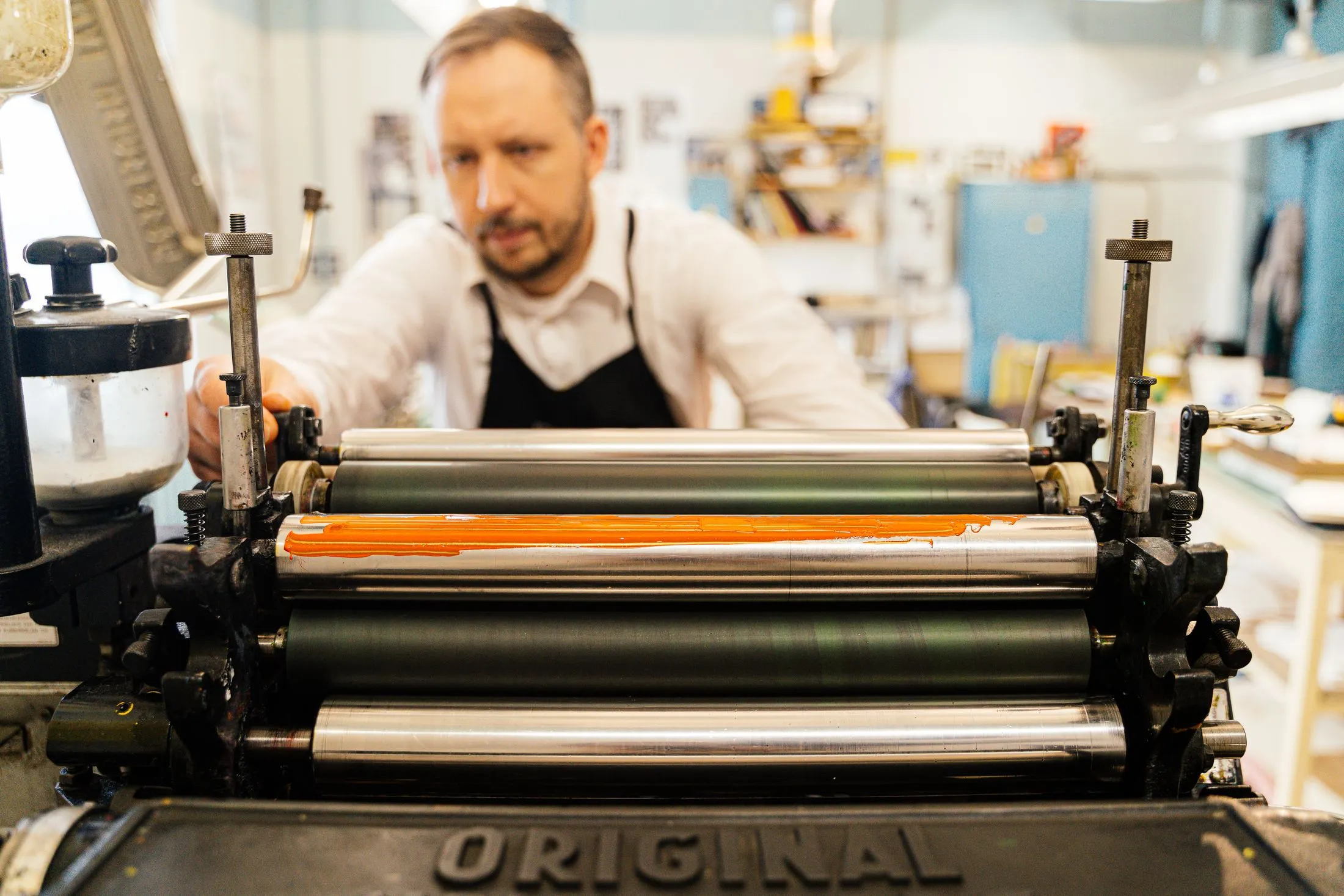
A printmaker operates a manual printing press in a workshop.COPYRIGHT / HUMAN CONTRIBUTION / SYMPLOKA
TOOLS CHANGE. CREATIVE CHOICES REMAIN.

A new tool does not answer the ownership question.

A generator can supply material while people still make choices about selection, arrangement, editing, and the final expression.

01 / THREE DIFFERENT QUESTIONS

“Who owns it?” can mean more than one thing.

Copyright in the resultDoes the finished work contain original expression that a person contributed under the law that applies?
Permission to use itWhat do the AI service’s current terms and the model’s license allow for this use?
Rights in training materialCould protected works have been used to train the model, and what rules apply to that provider?
Other people’s rightsDoes the work reproduce a protected work, use a mark, or identify someone’s voice or likeness?

A contract may grant permission to use an output without giving anyone an exclusive copyright in expression determined by a model. Copyright in an output and the legality of training are separate questions too.

02 / THE U.S. COPYRIGHT OFFICE

In U.S. guidance, human authorship turns on expressive control.

The U.S. Copyright Office’s January 2025 report says that AI-generated output can be protected where a human author determines sufficient expressive elements. It identifies human-authored expression that appears in an output, creative modifications, and original arrangements as possible contributions.

The Office’s report says that providing prompts alone is not enough when the system, rather than the user, determines the expressive details. It also says that AI assistance or AI-generated material inside a larger human-authored work does not automatically prevent copyright protection for the human contribution.

This is U.S. Copyright Office guidance. Its analysis is fact-specific and does not set a universal rule for every country or every use of AI.

03 / WHAT EU RULES COVER

The EU AI Act sets duties for model providers.

Article 53 of the EU AI Act requires providers of general-purpose AI models to put in place a policy for complying with EU copyright law, including rights reservations, and to publish a sufficiently detailed summary of training content. These requirements concern provider conduct and transparency about training.

They do not decide who owns a particular image, story, or design produced with an AI system. The European Commission describes the Code of Practice as a voluntary way for providers to demonstrate compliance with the Act’s obligations; the copyright and transparency duties themselves come from the regulation.

04 / WHAT A PERSON CONTRIBUTED

Look at the work process, not only the prompt.

A short prompt and a generated imageIn the U.S. Office’s current analysis, the prompt alone does not establish enough control over the image’s expressive details.
A human work used as an inputHuman-authored expression that remains perceptible in the output may still matter. The rights to that source work remain a separate question.
Original edits and arrangementMeaningful human changes or a creative selection and arrangement may be protectable, depending on the work and the jurisdiction.
A familiar character, logo, or voiceCopyright is only one part of the check. Trademark, privacy, publicity, and other rights may also apply.

Keep evidence of human choices that shaped the final work: sketches, source files, edits, selected outputs, and the way components were arranged. A long prompt history can document the process, but effort alone does not answer the authorship question.

05 / BEFORE COMMERCIAL USE

Check the contract, the source material, and the final work.

  1. Identify the country or countries where you plan to publish, sell, or distribute the work.
  2. Read the specific service terms and model license in force when you created the work. Check commercial use, attribution, ownership language, and any restrictions.
  3. Separate the parts you created from material the model generated, then save drafts, edits, and the final source files.
  4. Check any reference images, text, music, logos, names, or recognizable people included in the result.
  5. For an important release or a rights dispute, get a review based on the actual work, contract, and jurisdiction.
Tool, model, and terms date:
Human-created source material:
AI-generated portions:
Human edits and arrangement:
Third-party works, marks, or likenesses:
Planned use and countries:
Evidence and permissions retained:
06 / TRAINING IS A SEPARATE DEBATE

Training-data rules do not settle authorship of an output.

Copyright questions about using protected works to train a model are different from questions about copyright in a generated result. On its current AI page, the U.S. Copyright Office lists its Part 3 report on generative AI training as pre-publication. In the EU, Article 53 places specific copyright-policy and training-summary obligations on general-purpose model providers.

A public training-content summary is useful transparency. It is not, by itself, a license to reuse every work named in it or a ruling on whether a particular training use was lawful.

PRIMARY LEGAL SOURCES & GUIDANCEU.S. Copyright Office, Copyright and Artificial Intelligence, Part 2: Copyrightability (2025) ↗U.S. Copyright Office, Copyright and Artificial Intelligence initiative and report status ↗Regulation (EU) 2024/1689, Article 53: general-purpose AI model provider obligations ↗European Commission, general-purpose AI obligations under the AI Act ↗European Commission, General-Purpose AI Code of Practice ↗

This guide compares U.S. Copyright Office guidance and EU provider obligations; a real rights decision depends on the applicable law and the work itself.