JOURNAL / AI & WEATHER

AI weather forecasts.
From data to futures.

Machine-learning models can predict large-scale weather patterns at remarkable speed. Their real test is whether a forecast stays useful for the place, variable, and decision that matter.

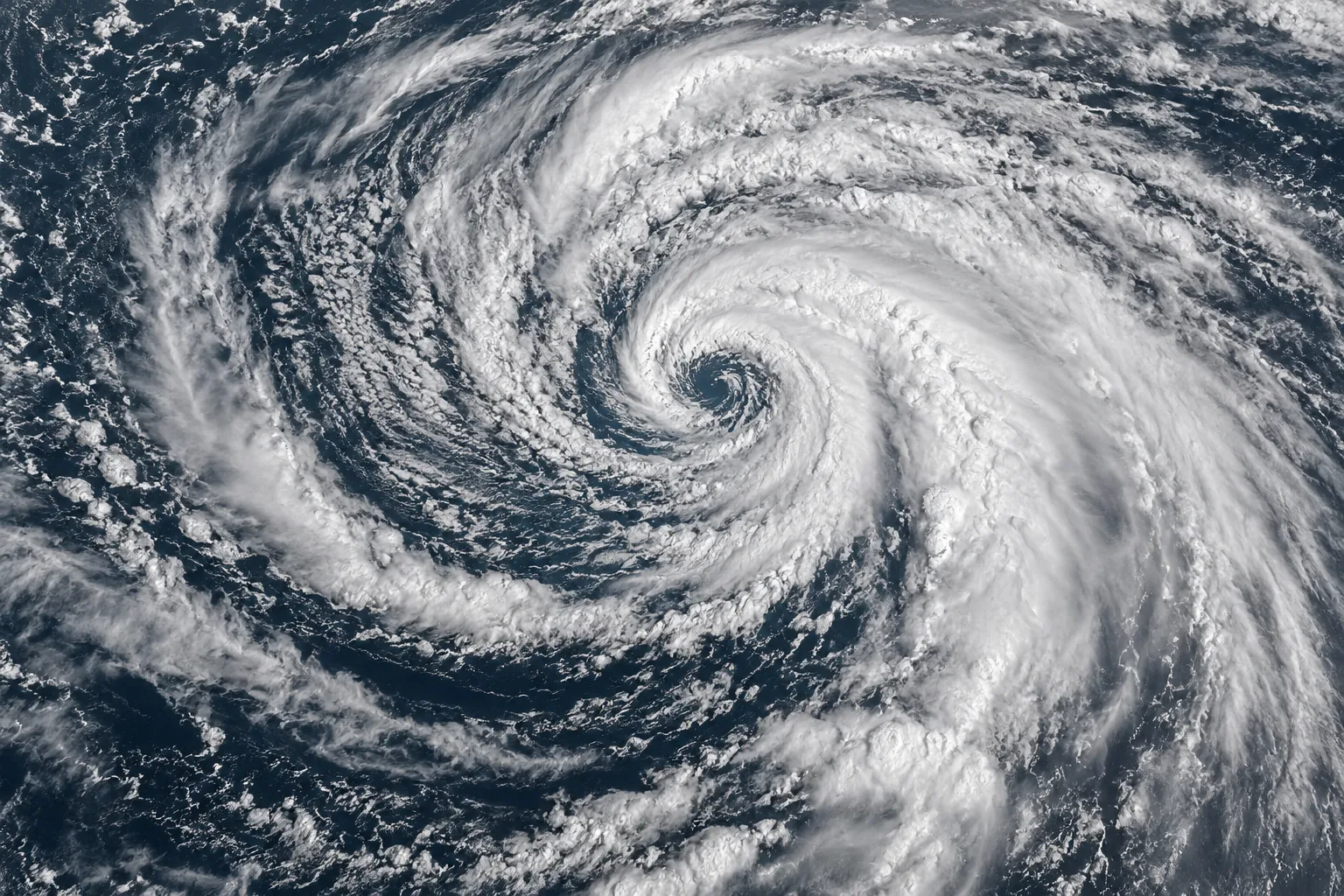
A vast spiral of cloud bands over a dark ocean, viewed from above.ATMOSPHERE / MODEL / FORECAST / SYMPLOKA
A FORECAST IS A TESTABLE PREDICTION

The atmosphere changes. The model must keep up.

AI weather systems learn how atmospheric states evolve, then feed each predicted state into the next step. Small errors can grow as the forecast moves forward.

01 / THE ATMOSPHERE AS INPUT

A model needs an estimate of the weather right now.

Weather services combine measurements from satellites, weather balloons, aircraft, ships, radar, and ground stations. Data-assimilation systems use these observations together with a previous forecast to estimate the current atmospheric state. That analysis is the starting point for many forecasts, including machine-learning systems.

The raw measurements are incomplete: instruments observe different parts of the atmosphere, at different times and scales. A forecast model does not remove that uncertainty. It begins with the best available estimate, then projects possible future states.

02 / LEARNING A FORECAST STEP

Train on weather histories. Predict the next state.

Many machine-learning weather models train on reanalysis: historical records that combine observations with a consistent numerical reconstruction of the atmosphere. During training, the model learns how patterns in one or more atmospheric states relate to a later state. That is different from asking a text model to search the web for tomorrow’s forecast.

GraphCast is one example. It takes two recent weather states and predicts the next one. The model uses a graph neural network to pass information across a multi-scale representation of the globe. To forecast further ahead, it feeds its own latest prediction back in and repeats the step.

In the published study, GraphCast was trained on ERA5 reanalysis data from 1979 through 2017, with 2018 held out for testing. The authors reported better scores than ECMWF’s HRES deterministic system on 89.3% of the 2,760 evaluated variable-and-lead-time targets. That result belongs to the study’s chosen data, targets, and comparison protocol; it is not a universal ranking for every forecast.

Lam et al., GraphCast, Science (2023) ↗
03 / ONE TRAJECTORY OR A RANGE

An ensemble makes uncertainty part of the forecast.

Deterministic forecastProduces one sequence of predicted states from one initialized run. It is useful for a clear scenario, but does not by itself show how plausible alternatives compare.
Probabilistic forecastProduces an ensemble or distribution of possible outcomes. Its value depends on both accuracy and calibration: events assigned a probability should occur at roughly the stated frequency over repeated cases.

GenCast uses a diffusion-based model to produce an ensemble of global, 15-day forecasts. In its Nature evaluation, the authors compared probabilistic skill with ECMWF’s ENS ensemble using continuous ranked probability score (CRPS), which evaluates a predicted distribution against the outcome. The mean pooled CRPS was better for GenCast on 98.1% of 5,400 targets in that test, and the maximum-pooled CRPS was better on 97.6%.

Those percentages count targets where one score was better; they do not mean that 98.1% of individual forecasts were correct. A scorecard summarizes a defined evaluation suite. It cannot guarantee that a particular storm, town, or lead time will be easier to forecast.

Price et al., GenCast, Nature (2025) ↗
04 / FROM BENCHMARK TO OPERATIONS

AI forecasting now runs beside physics-based systems.

Numerical weather prediction advances an estimated atmosphere through equations for fluid motion and other physical processes. Machine-learning models learn a prediction step from data. Weather centres can compare both approaches, run ensembles, and combine their strengths in a larger forecast service.

ECMWF’s Artificial Intelligence Forecasting System (AIFS) is an operational example. Its deterministic model has run operationally since February 2025 and its ensemble since July 2025. ECMWF upgraded both to version 2 in May 2026. The current system issues forecasts at six-hour intervals out to 15 days, initialized from ECMWF’s operational analysis, and runs alongside its Integrated Forecasting System.

That is evidence of operational use, not evidence that one model has replaced the other. A forecast service also depends on incoming observations, initialization, post-processing, verification, and the people responsible for communicating warnings.

ECMWF AIFS versions, data, and forecast details ↗
05 / WHY EXTREME EVENTS NEED THEIR OWN CHECKS

Average skill can hide an important miss.

Rare events are difficult to evaluate because there are fewer examples, and an overall average can hide the variables that matter for a particular hazard. A 2024 study tested GraphCast, Pangu-Weather, and FourCastNet against HRES in three high-impact events. The models did not produce one consistent winner: they performed similarly in parts of the Pacific Northwest heatwave, underperformed when some errors were aggregated across that event, and did better than HRES on the North American winter storm.

For the South Asian humid heatwave, the tested machine-learning systems lacked some variables needed to assess health risk. Using a substitute, the study found that the models underestimated dangerous heat-index values in parts of Bangladesh. These findings apply to the specific models and cases studied; they show why a global benchmark cannot stand in for impact-focused evaluation.

Pasche et al., validating AI forecasts on high-impact extremes ↗
06 / HOW TO REVIEW A WEATHER-AI CLAIM

Ask what was predicted, against which evidence, and where.

Same starting pointWere the AI and reference forecasts initialized from comparable observations and analyses?
Same questionCompare the same variables, pressure levels, lead times, grid scale, and verification data.
Probability qualityFor an ensemble, check calibration and whether it represents the range of plausible outcomes.
Local impactTest the exact region and hazard. A global average can hide weaker performance on a rare or compound event.
Whole forecast serviceTrace observations, initialization, post-processing, operational monitoring, and how a warning reaches people.

The useful question is not whether AI or physics wins in the abstract. It is which forecast performs better for a defined variable, place, lead time, and decision—and how the service handles uncertainty when the forecast is wrong.

PRIMARY RESEARCH & OPERATIONAL DATALam et al., Learning skillful medium-range global weather forecasting, Science (2023) ↗Price et al., Probabilistic weather forecasting with machine learning, Nature (2025) ↗ECMWF, AIFS machine-learning forecast data and operational versions ↗Pasche et al., Validating deep-learning weather forecasts on high-impact extreme events (2024) ↗